
Introduction: The Collaborative Imperative in Modern Marketing
The modern marketing landscape is a dynamic, interconnected ecosystem. Gone are the days when marketing departments operated in isolation, their strategies dictated by internal silos. Today's customer journey is multifaceted, demanding seamless integration across various functions to deliver exceptional experiences and drive measurable business outcomes. To thrive in this environment, marketing teams must embrace cross-functional collaboration, transforming from individual departments into cohesive, unified forces. This shift isn't merely an operational upgrade; it's a strategic imperative that underpins innovation, agility, and ultimately, sustained success. This guide provides a practical roadmap for building, nurturing, and optimizing cross-functional marketing teams, empowering them to overcome challenges, unlock potential, and achieve unprecedented results.
The Collaborative Imperative in Modern Marketing
The relentless pace of digital transformation and evolving market trends has fundamentally reshaped how businesses connect with their audiences. Consumers expect consistent, personalized interactions across every touchpoint, from initial awareness to post-purchase engagement. This complex reality necessitates a departure from traditional, siloed departmental structures.
The Evolving Marketing Landscape and the Need for Integration
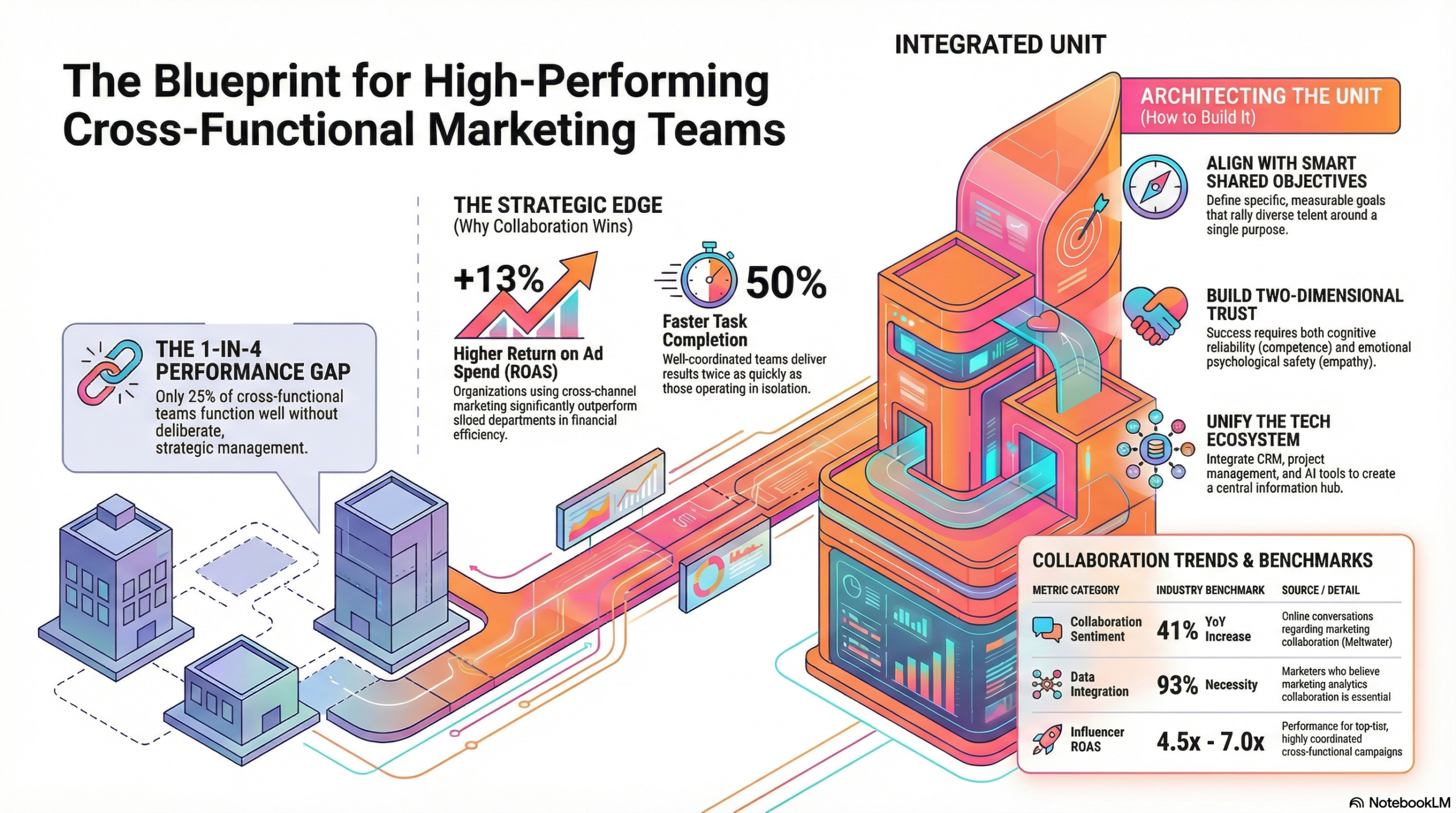
The digital age has democratized information and amplified customer voices, making customer experience the ultimate differentiator. Marketers now face the challenge of orchestrating a holistic customer journey, a task impossible to achieve without breaking down internal barriers. The increasing relevance of marketing collaboration is evident, with online conversations about marketing and collaboration increasing by 41% year-over-year (YoY) [Meltwater, 2024]. This surge reflects a growing industry recognition that fragmented efforts dilute impact and hinder progress.
Defining Cross-Functional Marketing Teams: More Than Just Departments
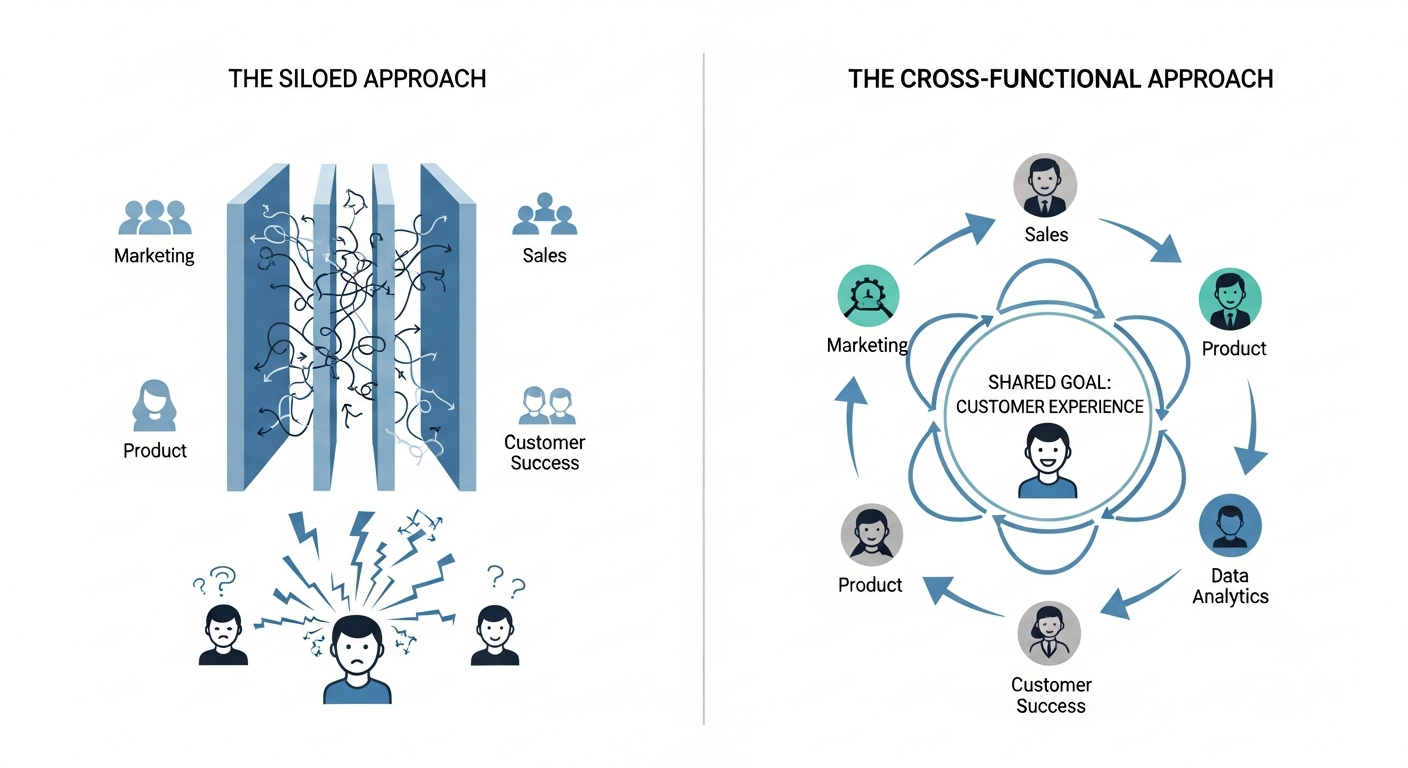
From Silos to Synergy: A cross-functional team breaks down departmental walls, uniting diverse expertise around a shared objective to create a cohesive customer experience.
A cross-functional marketing team is not simply a collection of individuals from different marketing departments. It is a deliberate assembly of talent from various disciplines—marketing, sales, product, customer success, data analytics, and beyond—united by shared Goals and a common objective. This collaborative unit leverages diverse perspectives and skill sets to tackle complex marketing challenges, from developing comprehensive campaigns to launching innovative products. The essence of such a team lies in its integrated approach, transcending departmental boundaries to achieve collective success.
Why Collaboration is No Longer Optional: Benefits of a Unified Approach
The advantages of a unified, cross-functional approach are profound and far-reaching. Firstly, it dramatically elevates the customer experience. When marketing, sales, and customer success teams work in tandem, they create a cohesive narrative and consistent support for the customer, reducing friction and fostering loyalty. This synergy directly impacts the bottom line. Companies employing cross-channel marketing experience a 13% higher ROAS compared to those with siloed approaches [Amra & Elma, 2025]. Furthermore, breaking down silos fosters agility and innovation. Teams can respond more rapidly to market shifts, iterate on strategies, and develop more creative solutions. However, the path to effective collaboration is fraught with challenges; only one in four cross-functional teams functions well, on average [Harvard Business Review, 2024]. This underscores the need for deliberate strategies to build and sustain high-performing teams.
What You'll Learn: A Practical Roadmap to Success
This guide will equip you with the knowledge and tools to navigate the complexities of cross-functional marketing team building and management. We will delve into the strategic imperatives that drive their creation, dissect the essential components of architecting an effective team, explore the critical role of culture in fostering trust and transparency, and provide actionable strategies for streamlining workflows and leveraging technology. By the end of this article, you will have a comprehensive understanding of how to foster collaboration, align your teams, and ultimately drive tangible business growth through a unified marketing approach.
The Strategic Imperative: Why Cross-Functional Marketing Teams Win
The decision to form cross-functional marketing teams is driven by a clear understanding of the strategic advantages they offer. These teams are not just an operational choice but a fundamental shift in how marketing achieves its objectives and contributes to overall business success.
Elevating the Customer Experience and Optimizing the Customer Journey
At the heart of successful cross-functional marketing is the customer. By integrating efforts across departments, organizations can create a seamless and consistent customer experience from the initial marketing touchpoint through to sales conversion and post-purchase support. This holistic view ensures that every interaction reinforces the brand message and value proposition. When marketing and sales departments are aligned, for instance, the transition for a potential customer is smoother, leading to better engagement and a higher likelihood of a deal closing. Understanding and mapping the entire customer journey becomes a shared responsibility, allowing for targeted interventions and personalized experiences that drive satisfaction and advocacy.
Driving Tangible Business Growth and Marketing ROI
The impact of cross-functional collaboration extends directly to financial performance. When teams are aligned on Goals and work collaboratively, marketing becomes a more efficient engine for growth. For example, average influencer marketing campaigns deliver 2.5-3.5x ROAS across industries, with top-performing campaigns achieving 4.5-7x returns, a success often amplified through coordinated efforts between influencer marketing specialists and content creation teams [Amra & Elma, 2026]. Moreover, improved alignment between marketing and sales can significantly boost revenue. By sharing insights and coordinating strategies, these teams can optimize lead nurturing, enhance sales enablement materials, and ultimately improve the velocity of deals, directly contributing to revenue growth and a better marketing ROI.
Breaking Down Silos: Fostering Internal and External Alignment
Departmental silos are a significant impediment to effective marketing. They create information gaps, lead to redundant efforts, and result in a disjointed customer experience. Cross-functional teams actively dismantle these barriers by fostering open communication and shared understanding across different functions. This internal alignment ensures that all stakeholders are working towards common Goals, with a unified message delivered externally. This comprehensive approach strengthens brand consistency and improves the overall perception of the organization. Companies that successfully break down these silos see a tangible improvement in their financial outcomes.
Cultivating Innovation, Agility, and Adaptability
In today's rapidly evolving marketplace, the ability to innovate and adapt is paramount. Cross-functional teams, by their very nature, are fertile ground for innovation. Bringing together diverse perspectives—from creative marketers to data analysts and product developers—sparks new ideas and solutions. This diverse input fuels agile marketing practices, allowing teams to quickly pivot, test new approaches, and respond to emerging market trends. Embracing digital transformation and adopting agile methodologies within a cross-functional framework enables organizations to stay ahead of the competition, refine their strategies based on real-time feedback, and maintain a dynamic, responsive marketing function.
Architecting Your Cross-Functional Marketing Dream Team
Building a successful cross-functional marketing team requires more than just assembling individuals; it demands a strategic approach to defining purpose, identifying roles, and structuring the team for optimal performance.
Defining Clear Goals and Shared Objectives
The cornerstone of any high-performing team is a clear, shared vision. Before assembling a cross-functional marketing team, it is imperative to define precise Goals and Objectives that all members can rally behind. These Goals should be SMART (Specific, Measurable, Achievable, Relevant, Time-bound) and directly linked to overarching business objectives. Whether the aim is to increase customer acquisition, enhance brand loyalty, or successfully launch a new product, clarity on these shared objectives ensures that every team member understands their contribution and the collective purpose of their efforts. This shared understanding is the first step in achieving effective cross-functional collaboration.
Identifying Key Roles and Specialized Skills for Collaboration
A successful cross-functional marketing team comprises individuals with diverse expertise. Beyond core marketing disciplines like content, digital, and brand management, roles from sales, product development, data analytics, and customer success are vital. For instance, a product launch requires input from product managers for feature understanding, sales for market positioning and customer needs, and marketing for campaign strategy and execution. Identifying individuals with complementary skills—such as strategic thinking, analytical prowess, creative problem-solving, and excellent communication—is crucial. This ensures that the team possesses the full spectrum of capabilities needed to address complex marketing challenges and drive project success.
Crafting the Ideal Team Structure and Organizational Fit
The structure of a cross-functional marketing team should be flexible and adaptable, aligning with the specific project or initiative at hand. This could range from a dedicated, long-term team focused on a strategic area like customer experience to a project-based team assembled for a specific campaign or product launch. The structure must facilitate clear reporting lines and decision-making processes, while also encouraging open communication and collaboration. Understanding how this team fits within the broader organizational framework and how it interacts with other departments and stakeholders is essential for smooth operation and effective integration.
Laying the Groundwork: The Team-Building Kickoff Meeting
A successful team-building kickoff meeting is critical for setting the stage for effective cross-functional collaboration. This initial gathering serves multiple purposes: it introduces team members, clarifies the project's vision and Goals, establishes communication protocols, and fosters an environment of mutual respect and understanding. It's an opportunity for early socialization, allowing individuals to connect on a personal level, which is foundational for building trust. During this meeting, establishing clear roles and responsibilities, outlining initial workflows, and setting expectations for communication and feedback loops are paramount. This proactive approach ensures that the team starts with a strong foundation, ready to tackle its objectives with clarity and cohesion.
Cultivating a Culture of Trust, Transparency, and Empathy
Beyond structure and process, the underlying culture of a cross-functional marketing team is the true determinant of its success. A culture built on trust, transparency, and empathy is essential for navigating the complexities of collaboration.
Building Foundational Trust: Emotional and Cognitive Dimensions
Trust is the bedrock of any effective team, especially one that spans different departments. This trust operates on two key dimensions: cognitive trust, which is based on the reliability and competence of team members (e.g., delivering on promises, possessing the right skills), and emotional trust, which stems from mutual respect, psychological safety, and a genuine sense of care among individuals. Leaders must actively foster both. Cognitive trust is built through consistent delivery and open acknowledgment of capabilities and limitations. Emotional trust is cultivated through encouraging vulnerability, active listening, and demonstrating empathy, creating an environment where team members feel safe to share ideas, admit mistakes, and offer constructive criticism without fear of reprisal.
Championing Open Communication and Feedback Loops
Transparency and open communication are vital for cross-functional marketing teams. When information flows freely, teams can identify potential roadblocks early, avoid duplication of effort, and make more informed decisions. Establishing regular communication channels and feedback loops—whether through daily stand-ups, weekly meetings, or dedicated communication platforms like Slack—ensures that everyone is kept in the loop. Encouraging honest, constructive feedback, delivered with respect and empathy, allows team members to learn from each other and continuously improve their processes and outcomes. This transparency in communication builds confidence and strengthens the collective intelligence of the team.
Empowering Shared Ownership and Collective Accountability
A sense of shared ownership is critical for motivating cross-functional teams. When team members feel that the success or failure of an initiative is a collective responsibility, they are more likely to be engaged and committed. This means moving away from individual departmental accountability for isolated tasks and embracing collective accountability for shared Goals. Leaders play a key role in fostering this by celebrating team successes, addressing challenges collaboratively, and ensuring that credit is shared equitably. This empowers individuals to contribute their best ideas and solutions, knowing their efforts contribute to a common triumph.
Leadership's Pivotal Role in Nurturing Cross-Functional Success
Leadership is the linchpin in nurturing successful cross-functional marketing teams. A designated leader, often acting as a "Marketing Owner" or "Agile Lead," must champion the team's mission, facilitate communication, and remove impediments. This leadership role involves actively managing stakeholders, ensuring their buy-in and alignment with the team's objectives. Leaders must create a vision, provide the necessary resources, and foster the culture of trust and transparency discussed earlier. Their ability to navigate competing priorities, mediate conflicts, and empower team members directly influences the team's effectiveness and its ability to achieve its strategic Goals.
Streamlining Marketing Workflows and Processes for Efficiency
Effective cross-functional collaboration hinges on streamlined workflows and optimized processes. This ensures that the team's diverse efforts are coordinated and productive, leading to efficient execution and impactful results.
Implementing Agile Marketing Methodologies in a Cross-Functional Context
Agile marketing methodologies, such as Scrum or Kanban, are exceptionally well-suited for cross-functional teams. These approaches emphasize iterative development, flexibility, and continuous improvement, allowing teams to adapt quickly to changing market conditions and customer feedback. Implementing agile in a cross-functional setting involves breaking down large projects into smaller, manageable sprints, conducting regular stand-up meetings to track progress and identify impediments, and holding sprint reviews to demonstrate completed work and gather feedback. This iterative process enhances team collaboration, improves transparency, and ensures that marketing efforts remain aligned with evolving business needs.
Mastering Creative Project Management and Workflows
Robust project management is essential for coordinating the diverse activities of a cross-functional marketing team. This involves defining clear project scopes, setting realistic timelines, assigning tasks, and monitoring progress against milestones. Creative project management in this context means embracing flexibility and adaptability, allowing for experimentation and iteration. Utilizing project management tools and frameworks helps visualize workflows, manage dependencies between different team members and departments, and ensure that all components of a marketing campaign or initiative are integrated seamlessly. Effective workflow design prevents bottlenecks and ensures a smooth progression from ideation to execution.
Efficient Resource Management and Allocation Strategies
Cross-functional teams often operate with finite resources, making efficient management and allocation critical. This involves understanding the capacity of each team member and department, prioritizing tasks based on strategic Goals, and allocating resources—time, budget, and personnel—accordingly. Leaders must be adept at identifying potential resource constraints early and proactively seeking solutions. Strategic resource allocation ensures that critical marketing initiatives receive the necessary support, while also preventing burnout among team members. This requires a data-driven approach to planning and ongoing assessment of resource utilization.
Decision-Making Frameworks for Clarity and Speed
Decisions within cross-functional teams can become complex due to diverse perspectives and potential conflicts. Establishing clear decision-making frameworks is crucial for maintaining momentum and avoiding paralysis by analysis. This might involve defining who has the final say on specific types of decisions, implementing consensus-building processes, or utilizing data-driven approaches to inform choices. For instance, 93% of marketers believe collaboration between marketing and analytics teams is essential for results [Amra & Elma, 2025], highlighting the importance of data in decision-making. Clear frameworks ensure that decisions are made efficiently, transparently, and with the collective best interests of the team and the organization in mind.
Leveraging Technology for Seamless Collaboration
In today's interconnected world, technology plays an indispensable role in facilitating effective cross-functional marketing collaboration, breaking down geographical barriers, and enabling real-time communication and coordination.
Essential Collaboration Platforms and Tools for Marketing Teams
A suite of collaboration tools is fundamental for modern cross-functional marketing teams. Platforms like Slack, Microsoft Teams, and Google Workspace provide robust communication channels, enabling instant messaging, video conferencing, and file sharing. Project management software such as Asana, Trello, or Jira helps teams organize tasks, track progress, and manage workflows. CRM systems (e.g., Salesforce, HubSpot) are vital for unifying customer data and ensuring alignment between marketing and sales efforts. Utilizing these tools effectively helps create a central hub for information and communication, significantly enhancing team cohesion and productivity.
Integrating Tools for a Unified Marketing Ecosystem
The true power of technology lies in its integration. Simply having a collection of tools is insufficient; they must work together to create a unified marketing ecosystem. This involves connecting communication platforms with project management software, integrating CRM data with analytics dashboards, and ensuring that information flows seamlessly between different applications. Such integration reduces manual data entry, minimizes errors, and provides a holistic view of marketing activities and their impact. This unified approach allows teams to access the information they need, when they need it, fostering better decision-making and more cohesive campaign execution.
The Role of AI-Powered Tools in Enhancing Collaboration
Artificial intelligence (AI) is increasingly being integrated into collaboration tools, offering new avenues for enhanced efficiency and effectiveness. AI-powered tools can automate repetitive tasks, analyze vast amounts of data to provide actionable insights, and even assist in content creation and optimization. For cross-functional teams, AI can help by identifying patterns in customer behavior, predicting campaign performance, and suggesting personalized marketing messages. Furthermore, AI can facilitate better knowledge management by organizing and surfacing relevant information from various sources, making it easier for team members to access the collective intelligence of the organization. Embracing these advanced tools can significantly boost a team's capacity for innovation and execution.
Measuring Impact and Driving Continuous Improvement
To ensure the long-term success of cross-functional marketing teams, it's essential to establish metrics for success and implement processes for continuous improvement.
Defining and Tracking KPIs for Cross-Functional Success
Key Performance Indicators (KPIs) are crucial for measuring the effectiveness of cross-functional marketing efforts. These KPIs should align with the team's defined Goals and reflect outcomes that are achievable through collaboration. Examples include metrics related to customer satisfaction, lead conversion rates, campaign ROI, speed of product launches, or improvements in customer journey completion rates. It's vital that these KPIs are not just departmental metrics but reflect the collective impact of the team. Tracking these metrics provides objective data on performance and identifies areas where the team is excelling and where further refinement is needed.
Regular Reviews and Feedback Loops
Continuous improvement is driven by consistent evaluation and adaptation. Cross-functional teams should establish regular review processes, such as weekly or bi-weekly meetings, to assess progress against KPIs, discuss challenges, and identify opportunities for optimization. These reviews should be candid and constructive, encouraging open dialogue about what is working well and what needs improvement. Feedback loops are essential, not just internally within the team, but also with external stakeholders. Gathering feedback from sales, product, and other relevant departments ensures that the marketing team remains aligned with broader business objectives and customer needs.
Adapting and Optimizing Based on Data
The insights gleaned from tracking KPIs and gathering feedback must be used to drive adaptation and optimization. This means being willing to adjust strategies, processes, and even team structures based on data and evolving market conditions. For instance, if data indicates that a particular campaign channel is not performing as expected, the cross-functional team should collaboratively analyze the reasons and pivot their approach. This data-driven adaptability is a hallmark of high-performing marketing teams and is essential for maintaining relevance and achieving sustained success in a dynamic environment.
Conclusion: The Future is Collaborative
The journey towards mastering cross-functional marketing teams is an ongoing process of strategic alignment, cultural development, and operational refinement. In today's interconnected business world, the collaborative imperative is no longer a choice but a necessity for survival and growth. By breaking down silos, fostering a culture of trust and transparency, and leveraging the right technologies, marketing teams can transcend their departmental origins to become powerful, integrated units.
The benefits are clear: enhanced customer experiences, accelerated business growth, and a more agile, innovative marketing function. Remember that only one in four cross-functional teams functions well on average [Harvard Business Review, 2024], but your organization can improve those odds by focusing on clear Goals, diverse skills, strong leadership, and continuous feedback. Well-coordinated teams are demonstrably more efficient, completing tasks 50% faster [9cv9 Career Blog, 2024].
To build your own successful cross-functional marketing team, start by clearly defining shared Objectives that resonate across departments. Invest in building a culture of psychological safety where empathy and open communication are paramount. Implement agile processes and leverage integrated collaboration tools to streamline workflows and ensure transparency. Critically, establish clear KPIs and use data-driven insights to foster continuous improvement. The future of marketing is not about isolated departments, but about unified teams working in concert to deliver exceptional value to the customer and drive significant business impact. Embrace this collaborative spirit, and you will unlock unparalleled potential for your organization.