
Growth vs. Performance Marketing: Mastering the Distinction for Smarter Strategy
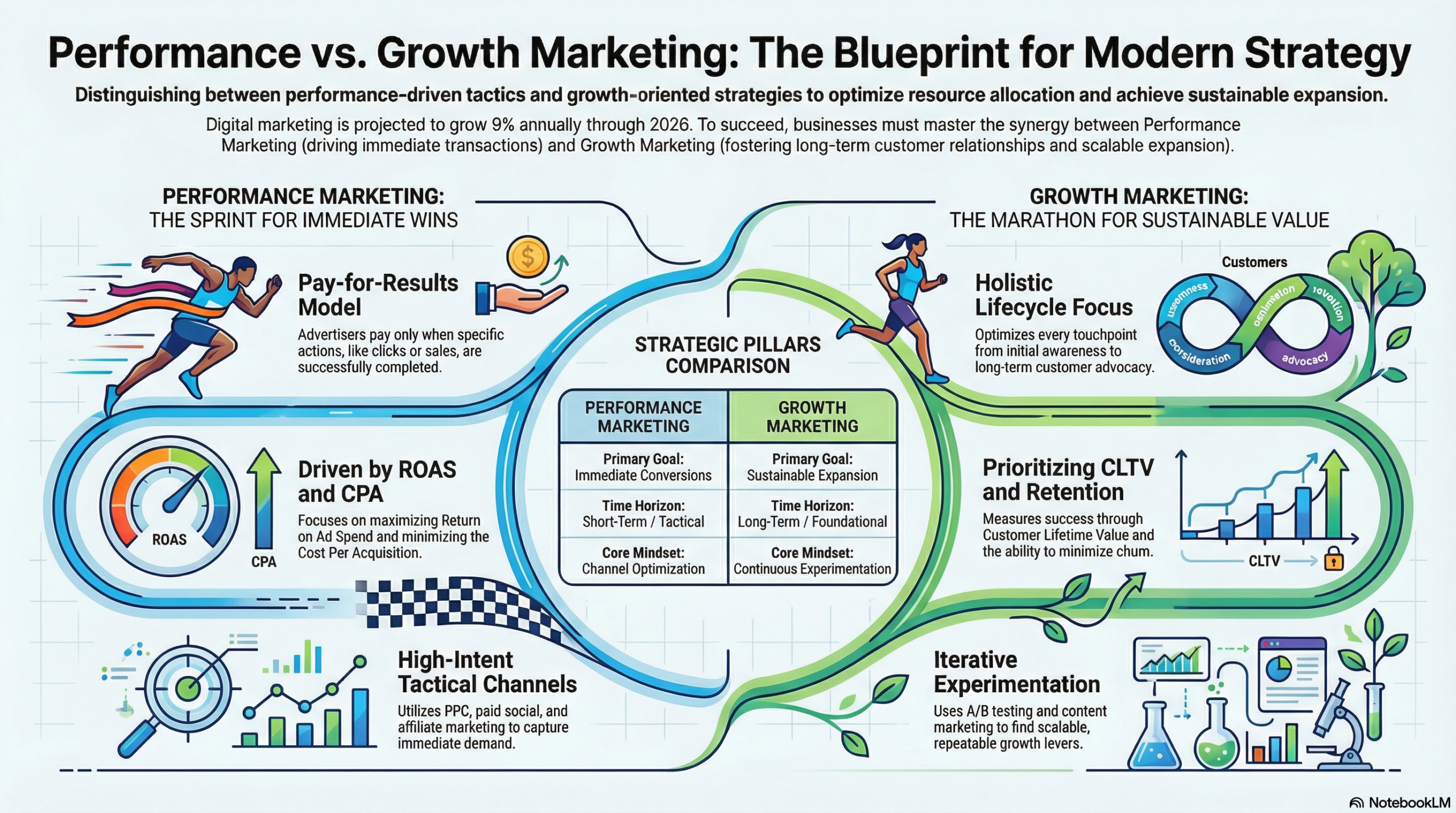
In today's hyper-competitive digital landscape, the pressure for businesses to achieve tangible results is immense. The constant evolution of technology, consumer behavior, and market trends presents both challenges and unprecedented opportunities for marketers. With the compound annual growth rate of digital marketing projected at a healthy 9% from 2020-2026 [WordStream, 2026], it's clear that digital channels are central to business success. However, navigating this complex ecosystem requires a nuanced understanding of different marketing approaches. Many businesses find themselves at a crossroads, grappling with how to best allocate resources and drive both immediate revenue and sustainable long-term expansion. This often leads to a fundamental question: how do growth marketing and performance marketing truly differ, and how can understanding these differences lead to smarter marketing strategies?
The Growing Complexity of Modern Marketing
The modern marketing arena is characterized by an explosion of channels, data sources, and ever-increasing customer expectations. Gone are the days of one-size-fits-all campaigns. Today, personalization is key; 59% of marketers report a positive ROI after incorporating personalization into their online stores [Involve.me, 2025], and a significant 63% of customers expect brands to understand their needs [HubSpot, 2025]. This shift demands a more sophisticated approach than simply broadcasting messages. Furthermore, the rapid integration of new technologies, such as AI, which is seeing a dramatic increase in security assessment from 37% in 2025 to 64% in 2026 [World Economic Forum, 2026], adds another layer of complexity. Marketers must not only understand their audience deeply but also leverage data to drive both immediate transactions and long-term customer relationships. This intricate environment necessitates a clear differentiation between strategies that focus on immediate results and those geared towards sustained, scalable expansion.
The Core Challenge: Understanding Growth vs. Performance
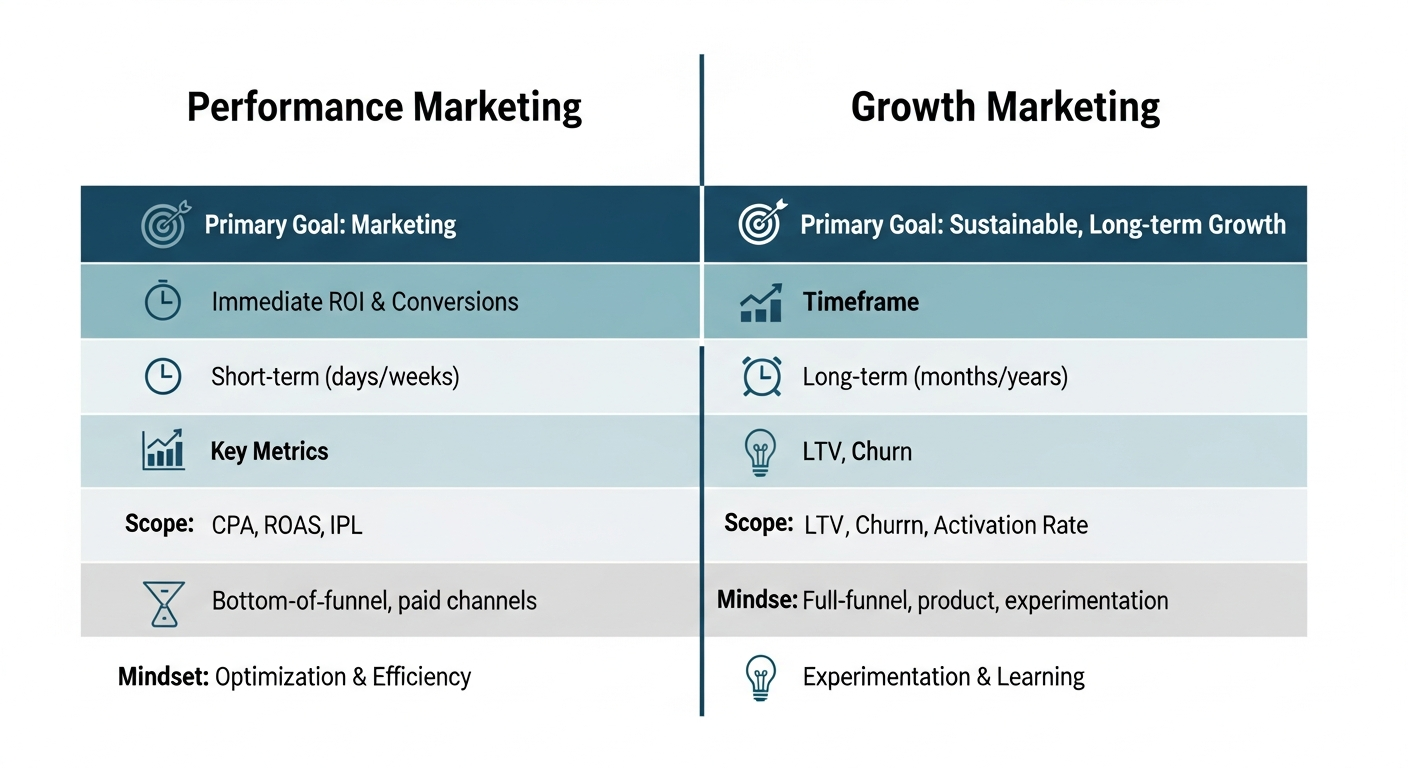
Key distinctions between Performance Marketing and Growth Marketing across goals, timeframe, metrics, scope, and mindset.
At the heart of this complexity lies the challenge of balancing immediate, measurable outcomes with the imperative for long-term business expansion. Many marketing efforts can be broadly categorized, but two prominent and often conflated terms stand out: performance marketing and growth marketing. While both aim to drive business success, they do so through different philosophies, strategies, and metrics. Understanding the fundamental differences between these two approaches is not just an academic exercise; it is a strategic imperative that directly influences how a business allocates its budget, structures its teams, and ultimately achieves its overarching business goals. This article will delve into the nuances of each, highlight their key differences, and explore how their integration can lead to a more robust and effective marketing strategy.
Unpacking Performance Marketing: Driving Immediate, Measurable Results
Performance marketing is a cornerstone of modern digital advertising, built on the principle of driving direct, measurable actions. It's about optimizing campaigns to achieve specific, predefined outcomes, making it a highly accountable form of marketing where effectiveness is directly tied to tangible results.
What is Performance Marketing?
Performance marketing is a type of digital marketing where advertisers pay only when a specific, predetermined action is completed. This action could be a click, a lead submission, a sale, or any other quantifiable conversion. The entire approach is inherently transactional and heavily reliant on robust data tracking and analysis to optimize for the best possible return on investment (ROI). Its efficacy is directly measured by the achievement of these defined actions, making it a results-oriented discipline that is crucial for businesses seeking immediate impact.
Core Characteristics and Goals of Performance Marketing
The primary characteristic of performance marketing is its results-oriented nature, with a strong emphasis on driving immediate wins. The core goals are typically focused on acquiring new customers, generating qualified leads, and driving direct revenue in the short to medium term. Key objectives include maximizing return on advertising spend (ROAS) and minimizing the cost per acquisition (CPA). This approach is particularly crucial for businesses that need to see a clear, immediate impact from their marketing spend, making it highly appealing for sales-driven organizations or those facing immediate revenue targets. The focus is on quantifiable actions that directly impact the bottom line.
Key Strategies and Tactics in Performance Marketing
Performance marketing encompasses a range of channels and tactics designed to elicit an immediate, measurable response. These often include:
- Pay-Per-Click (PPC) Advertising: Platforms like Google Ads and Bing Ads, where advertisers bid on keywords to appear in search results, paying only when a user clicks their ad. This is a direct way to capture intent-driven traffic.
- Paid Social Media Advertising: Utilizing platforms such as Facebook, Instagram, LinkedIn, and Twitter to run targeted advertising campaigns designed to drive specific actions, like website visits, app installs, or form submissions. These campaigns leverage sophisticated targeting options to reach precise audience segments.
- Affiliate Marketing: Partnering with affiliates who promote products or services and earn a commission for each conversion they generate. This performance-based model aligns incentives for maximum ROI.
- Search Engine Optimization (SEO): While often associated with long-term growth, specific SEO strategies can be employed to drive immediate traffic through high-intent keywords and targeted content, aiming for quick wins in search rankings.
- Display Advertising & Retargeting: Utilizing banner ads and other visual formats, often with retargeting campaigns to re-engage users who have previously visited a website but did not convert, reinforcing the message and driving them back to complete an action.
Essential Performance Marketing Metrics (KPIs)
Success in performance marketing is measured through a clear set of key performance indicators (KPIs) that directly reflect the cost and return of advertising efforts. These include:
- Cost Per Acquisition (CPA): The total cost of advertising divided by the number of acquisitions. This metric is paramount for understanding the efficiency of acquiring a new customer.
- Cost Per Click (CPC): The amount paid each time a user clicks on an ad, crucial for managing ad spend effectively.
- Click-Through Rate (CTR): The percentage of users who click on an ad after seeing it, indicating the ad's relevance and appeal.
- Conversion Rate: The percentage of website visitors or ad viewers who complete a desired action, a direct measure of campaign effectiveness. Optimizing the Conversion Rate is a key objective.
- Return on Advertising Spend (ROAS): Total revenue generated from advertising divided by the total advertising cost, providing a clear picture of profitability.
- Cost Per Lead (CPL): The total cost of advertising divided by the number of leads generated, essential for lead-centric campaigns.
- Real-time attribution: Understanding which touchpoints contributed to a conversion as it happens allows for immediate campaign adjustments and optimization, a critical component of effective performance marketing.
Demystifying Growth Marketing: Fostering Sustainable, Long-Term Expansion
While performance marketing focuses on immediate transactions, growth marketing takes a broader, more holistic view, aiming for sustained expansion and deep customer relationships. It’s about building scalable systems that drive continuous, long-term ‘growth.
What is Growth Marketing?
Growth marketing is a comprehensive, data-driven, and iterative approach to marketing that focuses on achieving sustainable business growth across all stages of the customer journey. It’s less about single campaigns and more about building a framework for continuous experimentation, learning, and optimization to drive long-term customer acquisition, retention, and advocacy. Growth marketing aims to expand the entire customer base and increase the lifetime value of those customers, fostering robust, long-term growth.
Core Characteristics and Goals of Growth Marketing
The defining characteristic of growth marketing is its emphasis on the entire customer lifecycle and its commitment to continuous experimentation. Its core goals extend beyond immediate sales to encompass customer loyalty, retention, and customer lifetime value (CLTV). Growth marketing seeks to understand and optimize every touchpoint a customer has with a business, from initial awareness to advocacy. It prioritizes building scalable, repeatable processes that foster continuous improvement and innovation. This approach often leverages content marketing, with 72% of marketers reporting content marketing increases engagement and leads [WinSavvy]. The ultimate aim is sustained, compounding growth that extends well into the future.
Key Strategies and Tactics in Growth Marketing
Growth marketing employs a wide array of strategies, often requiring cross-functional collaboration across marketing, sales, product, and customer service departments, to foster expansion:
- Content Marketing: Creating and distributing valuable, relevant content to attract and retain a clearly defined audience—and, ultimately, to drive profitable customer action. This builds trust and authority over time.
- Search Engine Optimization (SEO): Building robust organic search visibility to attract a consistent stream of qualified traffic over the long term, establishing a foundational channel for growth.
- Email Marketing & CRM: Nurturing customer relationships through personalized communication, segmentation, and automation to drive repeat purchases and loyalty. This is key for maximizing CLTV.
- Social Media Engagement: Building communities, fostering interaction, and leveraging social platforms for brand building and customer support, creating a loyal following.
- Referral Programs & Virality: Encouraging existing customers to bring in new ones through incentives and creating shareable experiences, driving organic growth.
- Product-Led Growth (PLG): Designing products that inherently drive user acquisition and retention, where the product itself becomes a primary marketing tool.
- A/B Testing and Experimentation: The backbone of growth marketing efforts involves continuous testing of hypotheses across various channels and touchpoints to identify what drives the most significant impact on long-term growth. This commitment to continuous experimentation is a hallmark of effective growth marketing.
Essential Growth Marketing Metrics (KPIs)
Growth marketing metrics focus on the long-term health and value of the customer base, often looking beyond immediate revenue to understand sustainable expansion. These include:
- Customer Lifetime Value (CLTV): The total predicted revenue a customer will generate throughout their relationship with a business. This is a crucial metric for assessing the long-term profitability of acquired customers.
- Customer Retention Rate: The percentage of customers who remain active over a specific period, indicating the stickiness of a product or service.
- Churn Rate: The percentage of customers who stop using a product or service during a given period, a critical indicator of customer satisfaction and product-market fit.
- Net Promoter Score (NPS): A measure of customer loyalty and satisfaction, indicating their likelihood to recommend the brand, a key driver of organic growth.
- Viral Coefficient: A metric measuring how many new users each existing user generates, essential for understanding organic growth loops.
- Customer Acquisition Cost (CAC) to CLTV Ratio: A key indicator of the long-term profitability of customer acquisition efforts, ensuring that acquisition costs are sustainable relative to the value customers bring.
- Marketing Qualified Leads (MQLs) and Lead Quality: As highlighted by 40% of marketers reporting lead quality as their most important metric [HubSpot State of Marketing Report, 2026], growth marketing aims to attract and nurture leads that have a high probability of converting into loyal, long-term customers.
The Key Differences: A Strategic Comparison
While both growth marketing and performance marketing are essential for business success, their fundamental differences lie in their objectives, scope, and underlying philosophy. Understanding these key differences is crucial for strategic planning and making the smart choice for your business.
Divergent Goals and Objectives
Performance marketing's primary goal is to drive immediate, measurable actions, such as sales or leads, with a strong emphasis on return on investment (ROI) for specific campaigns. In contrast, growth marketing aims for sustainable, long-term expansion of the customer base and increasing customer lifetime value (CLTV). This distinction in objectives dictates the types of strategies and metrics prioritized by each approach.
Focus and Scope: Tactical vs. Holistic
Performance marketing is often tactical, focusing on specific channels and campaigns designed for immediate impact, like a PPC campaign or a paid Social Media Marketing blitz. Growth marketing, however, adopts a holistic approach, considering the entire customer journey and often requiring cross-functional collaboration across marketing, sales, product, and customer service teams. This broader scope allows for deeper, more impactful long-term growth.
Time Horizon and Investment Philosophy
Performance marketing typically operates on a shorter time horizon, seeking quick wins and immediate profitability from advertising spend. Growth marketing adopts a longer-term investment philosophy, understanding that building customer relationships, brand loyalty, and sustainable acquisition loops takes time but yields greater long-term returns. This difference in time horizon is a critical factor in strategic planning.
Metrics and Measurement: Direct vs. Foundational Impact
Performance marketing relies on direct, action-based metrics like CPA, ROAS, and Conversion Rate to measure campaign success. Growth marketing looks at more foundational metrics that indicate the overall health and expansion of the business, such as CLTV, retention rate, and NPS. While performance marketing tracks immediate ROI, growth marketing focuses on the foundational elements that drive sustainable business value.
Approach and Mindset: Optimization vs. Experimentation
Performance marketing often focuses on optimizing existing campaigns for incremental gains, fine-tuning bids, creatives, and targeting. Growth marketing is characterized by a continuous cycle of experimentation, hypothesizing, testing, and learning to discover scalable growth levers. The mindset is one of iterative innovation and a constant pursuit of new growth opportunities. This commitment to continuous experimentation is a core tenet of growth marketing efforts.
Attribution Models: Direct vs. Multi-Touch
Performance marketing frequently utilizes simpler attribution models, often focusing on the last-click to assign credit to the campaign that directly drove the conversion. Growth marketing, with its focus on the entire customer journey, benefits from more sophisticated multi-touch attribution models that acknowledge the influence of various touchpoints leading to a customer's engagement or purchase. Understanding this difference in attribution is key to accurately measuring the impact of various marketing activities.
Why the Distinction Matters: Beyond Definitions to Strategic Impact
Mastering the distinction between growth and performance marketing moves beyond theoretical understanding to tangible strategic advantages that can profoundly impact a business. It’s about making a smart choice that aligns with specific business objectives.
Aligning Marketing Efforts with Business Goals
By clearly defining whether a marketing initiative is geared towards immediate revenue generation (performance) or long-term expansion (growth), businesses can ensure their marketing activities are precisely aligned with their overarching strategic business goals. This clarity prevents resources from being misdirected towards activities that don't serve the primary objectives. For instance, a company looking to quickly generate revenue might lean heavily on performance marketing, while one aiming for market leadership and customer loyalty would prioritize growth marketing.
Optimizing Resource Allocation and Budgeting
Recognizing the different objectives allows for more intelligent resource allocation. A business needing immediate cash flow might heavily invest in performance marketing campaigns, while one focused on market dominance and customer loyalty might allocate more budget to growth marketing strategies. Furthermore, 47% of marketers report leveraging automation to make marketing processes more efficient [HubSpot State of Marketing Report, 2026], a tool applicable to both but often scaled to support the broader reach of growth initiatives. Making the smart choice involves understanding where each strategy best serves immediate and future needs.
Fostering Effective Team Structures and Skillsets
Understanding the core differences helps in building the right teams. Performance marketing often requires specialists in paid media, analytics, and Conversion Rate optimization. Growth marketing, on the other hand, demands a more versatile team with skills in content marketing, SEO, community management, product marketing, and a strong propensity for experimentation and data analysis. This ensures teams are equipped with the specific expertise needed to execute their respective strategies effectively.
Preventing Misconceptions and Unrealistic Expectations
Clarity around these two approaches helps manage stakeholder expectations. Explaining that a performance campaign is designed for immediate sales, while a growth initiative is for long-term value, prevents misunderstandings about expected timelines and outcomes. It ensures everyone is on the same page regarding the purpose and anticipated results of different marketing efforts, fostering better alignment across the organization.
The Power of Integration: Combining Growth and Performance for Optimal Success
The most successful businesses don't view growth marketing and performance marketing as mutually exclusive but as powerful, complementary forces that, when integrated, create a compounding effect on overall business expansion. This integrated approach represents the ultimate smart choice for sustainable success.
Performance Marketing Fuels Growth Marketing
Performance marketing serves as a vital engine for acquiring initial customers. Channels like PPC, paid Social Media Marketing, and even targeted campaigns on platforms like MNTN Performance TV can quickly generate traffic and leads, providing the raw material—new users—that growth marketing strategies can then nurture. Effective acquisition campaigns drive traffic to valuable content or product offerings, initiating the customer lifecycle that growth efforts will optimize. The measurable outcomes from performance marketing provide the foundational data needed to scale.
Growth Marketing Enhances Performance Marketing
Conversely, insights gleaned from growth marketing efforts can significantly enhance performance campaigns. Understanding customer behavior, lifetime value, and retention drivers allows for more precise audience segmentation and targeting in performance advertising. For example, data on high-CLTV customer segments can inform the creation of lookalike audiences for paid acquisition campaigns, increasing their efficiency and return. By understanding the long-term value, performance marketing can be optimized to attract not just any customer, but the right customer for sustained growth.
Strategic Synergy Across the Customer Journey
When integrated, performance and growth marketing can create a seamless customer journey. Performance channels can drive initial awareness and acquisition, while growth marketing tactics take over to engage, convert, retain, and ultimately turn those customers into advocates. This cohesive approach ensures that every stage of the customer lifecycle is addressed strategically, maximizing overall impact and return. For instance, premium Connected TV (CTV) inventory can be used by performance marketers to reach new audiences effectively, while the data generated can inform growth marketing's understanding of customer personas. This synergy allows for both immediate wins and enduring, long-term growth.
Implementing a Smarter Strategy: Practical Steps
To harness the combined power of growth and performance marketing, businesses should consider the following practical steps:
- Define Clear Business Goals: Articulate overarching business objectives (e.g., revenue targets, market share, customer loyalty). Understand whether the immediate priority is revenue acquisition or long-term market penetration.
- Audit Current Efforts: Analyze existing marketing activities, identifying strengths, weaknesses, and opportunities in both performance and growth domains. Where are you seeing immediate measurable outcomes? Where are you building for the future?
- Strategically Allocate Resources: Budget and assign resources based on the defined business goals, prioritizing channels and tactics that best serve immediate needs and long-term vision. This might involve investing in performance marketing for quick wins and in content marketing and SEO for long-term sustainability.
- Foster Cross-Functional Collaboration: Break down silos. Ensure marketing, sales, product development, and customer success teams communicate and collaborate effectively. This is crucial for growth marketing, which relies on a holistic view.
- Embrace Continuous Experimentation: Implement a culture of testing and learning, a hallmark of growth marketing. This applies not only to creative and messaging but also to channel selection and strategy refinement.
- Leverage Technology for Optimization: Utilize tools that offer Automated Optimization, such as those found in advanced advertising platforms. MNTN Performance TV, for example, leverages this technology to refine campaigns and achieve measurable outcomes more efficiently.
- Integrate Data and Analytics: Ensure robust tracking and analytics are in place to provide real-time attribution and foundational insights. This data informs both performance optimization and growth strategy development.
- Consider Example Niches: For businesses like those selling health food bars, the strategy might involve using performance marketing to drive impulse buys through targeted social ads, while using content marketing and email nurturing (growth marketing) to educate consumers about health benefits and build brand loyalty for repeat purchases. The choice between performance and growth marketing, or their integration, depends heavily on the product and target audience.
Conclusion: Mastering the Art of Sustainable Growth
In conclusion, the distinction between growth marketing and performance marketing is not merely semantic; it is foundational to building effective, sustainable business strategies. Performance marketing excels at driving immediate, measurable results and acquiring customers efficiently through targeted advertising and clear calls to action. It is the engine that delivers tangible returns in the short term, with a focus on metrics like Conversion Rate and ROI. Growth marketing, on the other hand, adopts a holistic, experimental approach focused on fostering long-term customer relationships, maximizing lifetime value, and driving sustainable expansion across the entire customer journey. Its core lies in continuous experimentation and metrics like CLTV and retention.
The true strategic advantage lies in recognizing that these two disciplines are not competing forces but rather essential, synergistic partners. Performance marketing fuels growth marketing by bringing in new users and providing valuable data, while growth marketing enhances performance marketing by identifying high-value customer segments and informing more precise targeting. Platforms like MNTN Performance TV, with their Premium CTV Inventory and Automated Optimization capabilities, offer a powerful way to execute performance marketing with real-time attribution and measurable outcomes, while simultaneously contributing to broader brand-building objectives that support long-term growth.
By mastering the key differences and understanding the power of integration, businesses can move beyond a one-dimensional approach. They can make the smart choice to implement a unified strategy that leverages the strengths of both performance and growth marketing, paving the way for not just short-term wins, but enduring, sustainable business expansion. This comprehensive approach, embracing continuous experimentation and data-driven insights, is the future of intelligent marketing.