
Master Website Conversion: Proven CRO Strategies to Skyrocket Your Results
In today's hyper-competitive digital landscape, driving traffic to your website is only half the battle. The real challenge, and the ultimate key to sustainable growth, lies in converting those visitors into loyal customers, valuable leads, or engaged subscribers. Many businesses pour significant resources into marketing efforts, only to witness a substantial portion of their hard-earned traffic depart without taking the desired action. This is precisely where Conversion Rate Optimization (CRO) emerges as the indispensable discipline. CRO is the strategic and data-driven practice of transforming your existing website visitors into more valuable outcomes, effectively unlocking the hidden potential within your current audience. By focusing on optimizing the user experience and guiding visitors toward their goals, you can achieve a remarkable "multiplicación de resultados" – a multiplication of your results – without necessarily increasing your marketing spend. This comprehensive guide will equip you with proven CRO strategies designed to skyrocket your website's performance and drive tangible business growth.
Why CRO is Your Ultimate Growth Hack
While acquiring new traffic through various digital marketing channels is essential, an over-reliance on this strategy can prove costly and yield diminishing returns. Conversion Rate Optimization (CRO) presents a potent and cost-effective alternative by maximizing the return on your existing marketing investments. It focuses on ensuring that every visitor who arrives at your website has an optimal experience and is effectively guided towards desired actions. For established e-commerce websites, for instance, a median conversion rate hovers around 2.5% to 3% [convertibles.dev]. Even incremental improvements in this rate can significantly boost revenue and lead generation without requiring additional ad spend. CRO is fundamentally about identifying and rectifying leaks within your conversion funnel, ensuring that website visitors can effortlessly navigate, find what they need, and ultimately convert. It is a cornerstone of effective digital marketing, directly impacting your bottom line.
The Foundation: Deeply Understanding Your Website Visitors
Effective conversion rate optimization begins not with superficial tweaks to buttons or copy, but with a profound, data-backed understanding of the individuals who visit your website. Without a deep insight into your audience, any optimization efforts risk being misdirected and ultimately ineffective. Understanding your website visitors is the absolute prerequisite for any successful CRO strategy.
Defining Your Ideal Customer & Their Journey
Before you can effectively optimize for conversion, you must first clearly define your ideal customer. This involves developing detailed buyer personas that extend beyond basic demographics to encompass their needs, pain points, motivations, and the specific problems your product or service is designed to solve for them. Mapping their customer journey on your website is the subsequent critical step. From their initial entry point – whether through a targeted marketing campaign, an organic search result, or direct traffic – through various interactions, you must meticulously consider their path. What are they fundamentally seeking? What information do they require at each specific stage of their interaction with your brand? A comprehensive understanding of this intricate user journey allows you to proactively anticipate their needs, address potential concerns, and strategically remove any friction points that might impede their progression towards a desired outcome. This deep customer insight forms the indispensable foundation upon which all subsequent marketing and website optimization strategies are built.
Uncovering User Behavior: Qualitative Insights
While quantitative analytics tools can inform you about what users are doing on your website, qualitative research is essential for understanding why they are doing it. Tools such as heatmaps, session recordings, and user surveys provide invaluable insights into user behavior. Heatmaps visually represent where users click, how their mouse moves, and how far they scroll, effectively highlighting areas of intense interest as well as those that are consistently ignored. Session recordings enable you to meticulously watch individual user journeys unfold in real-time, revealing points of confusion, frustration, or unexpected detours. User surveys and direct feedback forms offer direct input from your website visitors regarding their experiences, preferences, and challenges. By synergistically combining these qualitative methods with quantitative data, you can develop a holistic and nuanced understanding of the User Experience and precisely identify the specific roadblocks that are hindering conversions. Understanding these underlying motivations, roadblocks, and encouraging factors is paramount for effectively optimizing the entire user journey.
Data-Driven Decisions: Leveraging Analytics for CRO
Data is the bedrock of effective conversion rate optimization. Without accurate measurement and diligent analysis, your optimization efforts are essentially speculative, based on guesswork rather than verifiable evidence. A truly data-driven approach ensures that all decisions are informed, leading to tangible, measurable improvements in your website's performance and overall website conversion rate.
Setting Up Your Analytics Foundation
The foundational step in any data-driven CRO strategy is the establishment of a robust and accurate analytics system. This typically involves the precise setup and configuration of powerful analytics tools such as Google Analytics, Adobe Analytics, and Amplitude Analytics. Crucially, before you can measure success, you must meticulously define what constitutes a "conversion" for your specific website. Is it a completed purchase, a submitted form, a downloaded resource, or perhaps a specific high-value page view? Clearly defining these key conversion goals within your analytics platform is not just important – it is paramount. This precise definition allows you to track progress accurately, attribute successes, and objectively measure the impact of every optimization effort you undertake. Without clearly defined website goals and a well-configured web analytics setup, effectively measuring success becomes an impossible task, leaving you blind to your true performance.
Deep Dive into Quantitative Analysis
Once your analytics are set up, dive into quantitative data. Analyze traffic sources to find where visitors come from and which channels drive engagement and conversions. Check key metrics like bounce rate and exit pages to see where users leave. Use time on page and scroll depth for engagement insights. Conduct a full funnel analysis to map user paths and identify drop-off points. Understanding these areas is crucial for targeted optimization, with deeper product analytics enhancing this for e-commerce sites.
Core CRO Strategies: Optimizing Key Website Elements for Conversion
With a solid understanding of your target audience, their behaviors, and the data generated by your analytics, you are now well-equipped to implement core CRO strategies. These strategies focus on optimizing the fundamental elements of your website, forming the essential building blocks for significantly improving your overall website conversion rate.
Crafting Irresistible Call-to-Actions (CTAs)
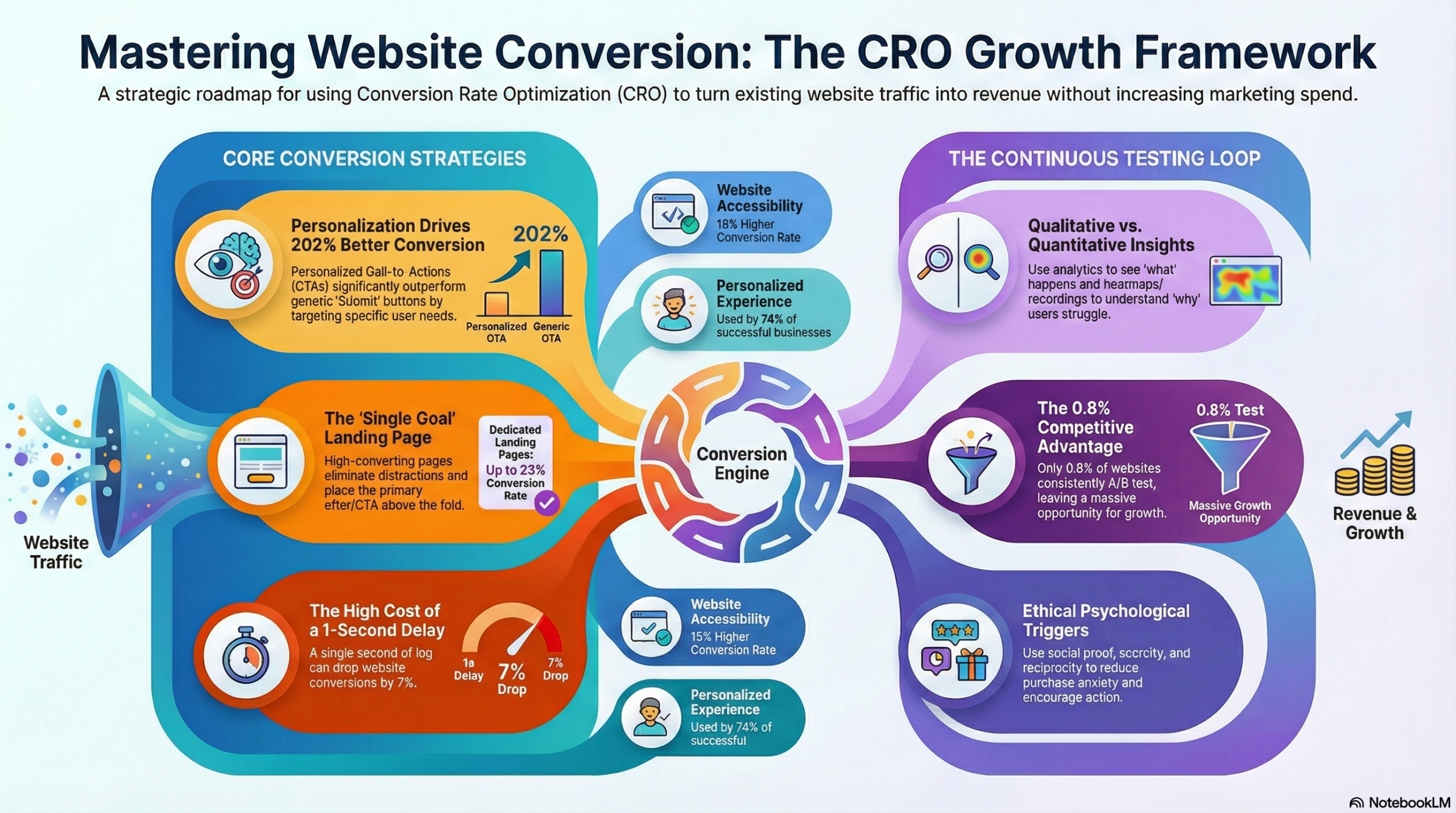
Call-to-Actions (CTAs) are essential for conversions on your site, guiding users with actions like "Buy Now" or "Sign Up." Effective CTAs are clear, persuasive, and prominently displayed. Use action-oriented language like "Get Your Free Quote" instead of "Submit" to highlight benefits. Design matters; CTAs should stand out with contrasting colors and sizes. Personalized CTAs can convert 202% better [WiserReview]. Relevant CTAs within content can boost lead generation by offering natural next steps.
Designing High-Converting Landing Pages
Landing pages are crafted for a single conversion goal, unlike more general pages. They eliminate distractions to focus user attention on a specific offer. Well-designed pages can convert up to 23% [WiserReview]. Essential elements include a captivating, benefit-focused headline, persuasive copy that meets user needs, and a clear offer aligning with user intent. Limit navigation links and emphasize a prominent CTA above the fold for maximum impact. Each landing page should focus on one clear objective to maintain its effectiveness.
Streamlining Forms and the Checkout Process
Friction in forms and checkout processes hinders website conversion. For forms, brevity is key; request only essential info. Use clear labels, intuitive fields, and instant validation to boost completion rates. In e-commerce, ensure a smooth checkout flow by reducing steps, offering guest checkout, and presenting clear shipping/pricing details. A cumbersome checkout process leads to high cart abandonment and lost revenue. Streamlining these interactions is crucial for converting users into customers.
Enhancing Website Usability and Speed
accessible counterparts [SearchAtlas], highlighting the broad benefits of prioritizing usability.A difficult-to-navigate or slow-loading website will suffer from low conversion rates. User Experience (UX) is critical, guiding or repelling visitors. Intuitive navigation helps users find what they need easily, and a clean layout reduces cognitive load. Speed is crucial; even a 1-second delay can drop conversions by 7% [Wahha Design]. Optimize images, cache, and code. Ensure responsive design and mobile optimization, as much traffic is mobile. Accessible websites see a 15% higher conversion rate than non-accessible ones.
Advanced CRO Tactics: Elevating Your Conversion Game
Once the core strategies for optimizing key website elements are in place and performing well, it’s time to explore more advanced tactics. These techniques can further refine your conversion process, foster deeper connections with your audience, and unlock new levels of performance.
Personalization at Scale
In today's digital age, users demand personalized experiences. By using data to tailor content, offers, and recommendations, engagement and conversion rates can be boosted significantly. This includes dynamic website content based on user behavior and personalized email marketing that resonates more. Notably, 74% of businesses now use website personalization [Blogging Wizard], highlighting its vital role and competitive edge. Delivering relevant info at the right time increases conversion chances. AI-powered recommendation engines excel here, particularly on product pages.
Harnessing Psychological Triggers for Persuasion
Human psychology principles are key for effective CRO. Triggers like scarcity ("Limited stock"), social proof (reviews), authority (endorsements), and reciprocity (free resources) can ethically boost actions. Simplifying pricing and using social proof reduce purchase anxiety [WiserReview]. Applying these elements ethically enhances decision-making, driving higher conversions.
Content Strategy for Conversion
Content marketing is crucial for attracting and nurturing leads but also significantly impacts conversions. Engaging blog posts, ebooks, webinars, and case studies educate audiences, build trust, and guide them toward converting. Ensure your content has relevant CTAs aligned with the topic. For instance, a blog on a user issue should link to a solution-focused product page or lead magnet. This approach shifts passive reading into active engagement, boosting conversion rates.
The Engine of Improvement: Rigorous Testing and Iteration
Conversion rate optimization is not a static, one-time project; it is an ongoing, iterative process. To truly uncover what resonates most effectively with your audience and consistently drives optimal results, rigorous testing and continuous iteration are absolutely essential. This commitment to experimentation is what fuels sustainable growth.
Principles of Effective CRO Experiments
Before starting a CRO experiment, create clear, testable hypotheses. Identify what change could boost conversion rates and the reasoning behind it. Determine key metrics to objectively assess success or failure. Without a solid hypothesis and defined metrics, evaluating results is futile. Test one major change at a time to accurately attribute any impact to that modification.
A/B Testing: Your Go-To Method
A/B testing, or split testing, is a leading method for website optimization, involving two versions of a webpage: the original (Version A) and a variation with a hypothesized change (Version B). These are shown to different, random visitor groups, and performance is measured against a conversion goal to see which is more effective. Surprisingly, only about 0.8% of websites consistently conduct A/B tests [WiserReview], revealing a major opportunity for gaining a competitive edge. This method bases optimization on actual user behavior, not assumptions.
Beyond A/B: Multivariate and Split URL Testing
A/B testing is great for single changes, but other methods suit complex scenarios. Multivariate testing (MVT) lets you test multiple element variations on one page, useful for seeing combined impacts and interdependencies. Split URL testing compares two different page designs for the same goal, often for major redesigns. The best method depends on your hypothesis's scope, change complexity, and traffic volume for significant results.
Specialized CRO Applications and Considerations
The fundamental principles of CRO are universally applicable across a diverse range of digital platforms and industries. However, certain contexts necessitate specific applications and considerations to maximize effectiveness.
E-commerce Conversion Optimization Deep Dive
For ecommerce sites, conversion optimization focuses on product pages and the buying process. Key tactics include using high-quality images, persuasive descriptions, transparent pricing, and customer reviews. To tackle cart abandonment, employ email reminders or exit-intent pop-ups with incentives. Streamlining checkout helps prevent lost sales. A well-optimized site boosts sales, average order values, and revenue. Additionally, AI-driven recommendations can enhance the shopping experience.
Mobile-First Conversion Rate Optimization Strategies
As mobile traffic grows, adopting a mobile-first CRO approach is essential. Prioritize mobile design and optimize user experience by ensuring responsive layouts, easy navigation, and appealing visuals on small screens. CTAs should be thumb-friendly, forms quick to complete, and pages fast-loading for slower networks. Ignoring mobile CRO risks losing many potential conversions as users may abandon poorly optimized mobile sites.
Building a Sustainable CRO Program and Future-Proofing
To achieve sustained, long-term success in conversion rate optimization, it must be deeply embedded within your organization's operational framework, rather than being treated as a standalone, infrequent project. A sustainable CRO program is one that fosters continuous learning and adaptation.
Integrating CRO with Your Business Strategy
CRO must be integrated with business goals and Sales and Marketing strategies. Align CRO with campaign goals, product launches, and sales targets to ensure direct contribution to business success. Cross-team collaboration among marketing, sales, product development, and design is essential for an effective strategy. Ultimately, CRO aims to boost leads and sales, driving sustainable growth.
Ethical CRO and Trust Building
Implement optimization strategies ethically and transparently to boost conversion rates. Be honest and clear, avoiding deceptive practices or misrepresentations. Respect user privacy and comply with data protection regulations like GDPR. Trust is essential for lasting customer relationships, enhancing brand image and loyalty. Ensure robust security and transparent compliance to build confidence and encourage repeat engagement.
The Future of CRO: AI and Beyond
CRO is rapidly evolving with emerging technologies like AI significantly impacting the field. AI enhances personalization, predictive analytics, and automates testing, analyzing extensive user data to reveal patterns and opportunities that might elude human analysts. Embracing these advancements is essential to refining your CRO strategy, ensuring future readiness, and sustaining competitiveness.
Conclusion: Your Journey to Conversion Mastery
Mastering website conversion is a continuous journey. Boost performance by understanding visitors, using data insights, and applying effective strategies. Compelling CTAs and high-converting landing pages are key. Optimize User Experience and conduct A/B testing. Embrace continuous improvement through testing, learning, and refinement. Align with your business strategy, uphold ethical practices, and stay curious about new technologies. Focused CRO unlocks your website's potential, turning visitors into loyal customers, driving sustainable growth. Start these strategies today to embark on your conversion mastery journey.